Tuesday, July 31, 2007
Sunday, July 22, 2007
Mona Lisa, inc.
Monday, July 16, 2007
Visual Art
That smile. That smile is what the whole controversy is about. Is she really smiling? Is she sad? Is she depressed? Or is it just her normal pose? Along with that are the other controversial elements involved in the analysis and investigation of the said painting. They are considering the background of the painting. They are also considering the pyramidal shape of Lisa's body. And one possible meaning that the "Mona Lisa" may portray is that it is about life. Why woman and not a man? Well basically because the moman is responsible for bearing leaders. The woman is the one who provides presidents, senators, singers, artists, and everyone else. For we all come from a woman, and with a woman's love and care, we are what we are right now. Also to support that "life" theme, the background is a landscape of nature, which in itself represents life, with all its greeneries and blue bodies of water.
No doubt, this is a masterpiece. So what makes an art a masterpiece? Basically, an art is considered a masterpiece when that certain art continues to persist throughout time, while still retaining its beauty and mystery. It will be considered a masterpiece when it still continues to bring out questions in us. For according to Ms. Castro, we live on this earth with a purpose, because we ask questions. Life will cease existing when questions stop being asked.
Sunday, July 1, 2007
"You made me believe"
Last Friday, Ms. Castro gave us an activity regarding what movie made the biggest impact in our lives. That may seem a simple question but it really isn't. We all have watched lots and lots of movies of different genres. And we all have our favorites per classification. So answering this particular question is a bit of a challenge. Many movies ran across my mind. From horror to sci-fi, sci-fi to action, and action to comedy.
But honestly, the most recent movie that had affected me is "Spider-Man 3". Ms. Castro also told us that basically, we like a particular movie because we can relate to it. We may have felt what the characters are experiencing in the different scenes in the movie. The line in which I was struck is when Peter Parker said in the ending, in Harry's funeral, "We always have a choice." That very simple line all made sense to me, and it somehow answered some of the thoughts that have been bugging me during summer, when I was dreading our Filipsy fieldwork. During that time, I was on the verge of giving up because no matter how hard we tried to perform out PTT, we just can't seem to do it right. And that line of Peter's, "We always have a choice", really woke me up to reality. That all that is happening around is in one way or another influenced by our own actions. So somehow, we fail because we chose to fail. If you just have done your best, then you wouldn't fail. So at that time, I made a choice. I chose to fight even if I had to make lots of sacrifices. And of course, that chose that I took was definitely a right thing to do.
So the point is that movies do not only entertain us. We can also learn from them. And things that are wanted to be said does not necessarily mean that you have to do it obviously. Simple lines such as the title of this post or the one that Peter Parker said can do many things to the movie as well as the audience.
Saturday, June 23, 2007
Dance and the Mis-en-scene
During the Dance Workshop held in the "William Shaw Little Theater", we were told of the different dances hailed from different countries and cultures. These dances hold different historical beginnings. We were told by the speaker, who is the choreographer for La Salle Street Dance Company, and Jazz that some dances resulted from the revolt of people. Some dances like the Classical Ballet, and the Modern Dance also share some characteristics in their execution and their movement itself.
Each kind of dance has its own meaning to speak of. The dance that struck me is the “Indian dance” because it is so unique and interesting. At first, I really found it creepy because of all those eerie dance steps, plus they used red light on the stage.
But in the middle of the performance, I appreciated it. I also liked the interpretative dance because even if they did not have to explain what they want to say in words, what they want to express is really evident in their dance movements.
Also one of my favorites is the “Maglalatik” because it is a very lively dance, and the performers themselves did a good job.
Maglalatik
In dancing with a group, you have to learn how to coordinate with your co-dancers so that you move as one, and breathe as one as well. I think that is one of the essential things in dancing. When you dance with a group, you must not also dance as if you’re the only one dancing. Do not outshine your co-dancers as it will seem that they are your backup dancers. Also another factor is the energy. You should learn how to channel and use energy depending on the different instances in which they are needed. These are just a few but they make up the essentials of dance.
In our class last Friday, Ms. Castro also pointed out to us the things that interact within the frame of the movie, which is also known as the mis-en-scene. She explained to us that the movie creators manipulate movie elements (lighting, sounds, camera positions, and angles) to express certain emotions or feelings without having to come from the character itself. For example, the scene in The Cinema Paradiso wherein Salvatore was walking away from Elena’s house during New Year. In that certain scene, words weren’t needed to express that Salvatore is heart-broken. The contrast in the mood and the lighting was enough to say that he really is sad. The camera angles also help in emphasizing what needs to be emphasized. Simple things that seem irrelevant to us also convey messages. For example, the breaking of a twig, or the dropping of a family portrait may signify a lot, and like I said these techniques and elements fall under the manipulation of the symphony of movie elements which belong to the mis-en-scene.

In this certain scene in the horror film "Silent Hill", it was not explicitly stated that she was going to be in danger. The lighting, special fog effects, and the long shot was enough to say so. She starts to get smaller and smaller as she moves forward, the camera still focusing at the sign. She is portrayed as small against the sign, which means that she is in for something she is unsure of and that she is in a foreign area.
Monday, June 18, 2007
music
Music is indeed a form of art. It is considered an art because it has substance, in the sense that you could freely express yourself and that what you express has meaning.
During the Music workshop, we were informed of the Intonation, Showmanship, Dynamics and Tempo. These elements make-up the orchestral performances. The De La Salle Chamber Ensemble started demonstrating the do's and dont's regarding the four elements. And when they started playing, I was really amazed. They rendered us with the classical pieces. And they all performed the pieces well. When listening to classical music, I feel peaceful. My mind just goes blank and I feel light. It is intriguing how those different musical instruments can make changes in how you feel. I believe that this type of music is even stronger than songs. But that also depends on how we perceive things. But that is how it works for me. Classical music seems so pure and powerful.
I remembered the time when Mom was forcing me to take up piano lessons, and also the time when I tried out learning the violin. I also remembered how I participated in other musical events when I was younger. This was when I realized that music really plays a big part in our lives. It was even pointed out to us that classical music can help make your kids smarter. It has also been known to hasten the ripening of certain fruits. Now one would wonder how all of these things work. That just proves how great music is. You could even see everyone hooked on to their mp3 players because music is part of their daily lives. Life without music is life without life at all.
Saturday, June 9, 2007
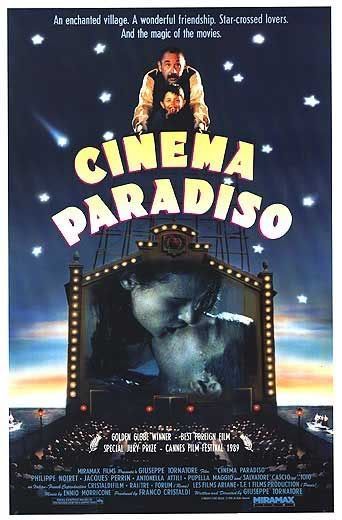
Cinema Paradiso
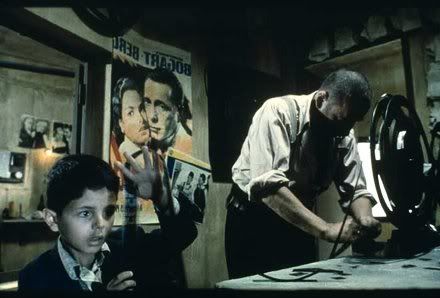
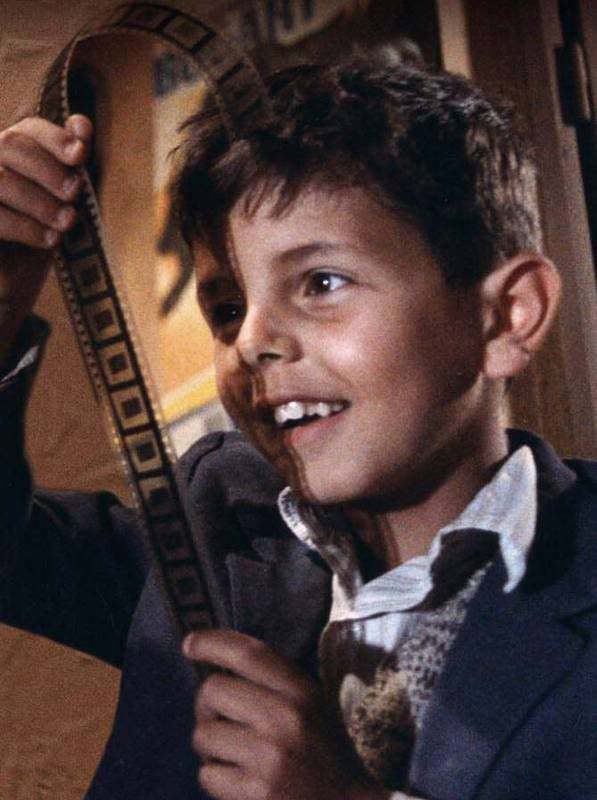
We watched Cinema Paradiso for Artapre. I must admit, I did not like it at first. But as the film progresses, I started liking it. The film is basically about Salvatore, who as a child was very fascinated and interested in film. He met the film projectionist Alfredo, who later also taught him how to project film reels on the screen.
Salvatore and Alfred
Later in the film, it was showed that Alfredo got blind because of a fire accident in the movie house. Salvatore replaced him as a projectionist, and he was doing rather well at it. In his adolescent years, Salvatore met a fine young woman named Elena. He liked her so much, and they eventually became lovers. But things got in their way, and eventually they were separated.
I also liked the scenes which involved the long shots. For example, Salvatore coming out of the bus in the plaza. Medium shots were also used well when they wanted to direct the viewers’ attention to the interaction of the characters in the movie.
For me, the film was very simple, yet it managed to affect me as a film viewer; the movie got through me. I would admit that some things were touching, particularly the scenes towards the end of the film. I appreciated how they chose the setting, the background tunes, and the lightning. These elements were creatively manipulated to create the desired scenes which would elicit the necessary emotions from the viewers.